Pretius. Built Smarter: Strategic merger as an answer to modern challenges
Pretius. Built Smarter:
Strategic merger as an answer to modern challenges

The Hidden Oracle Bill: Why the Same Workload Costs Less on OCI

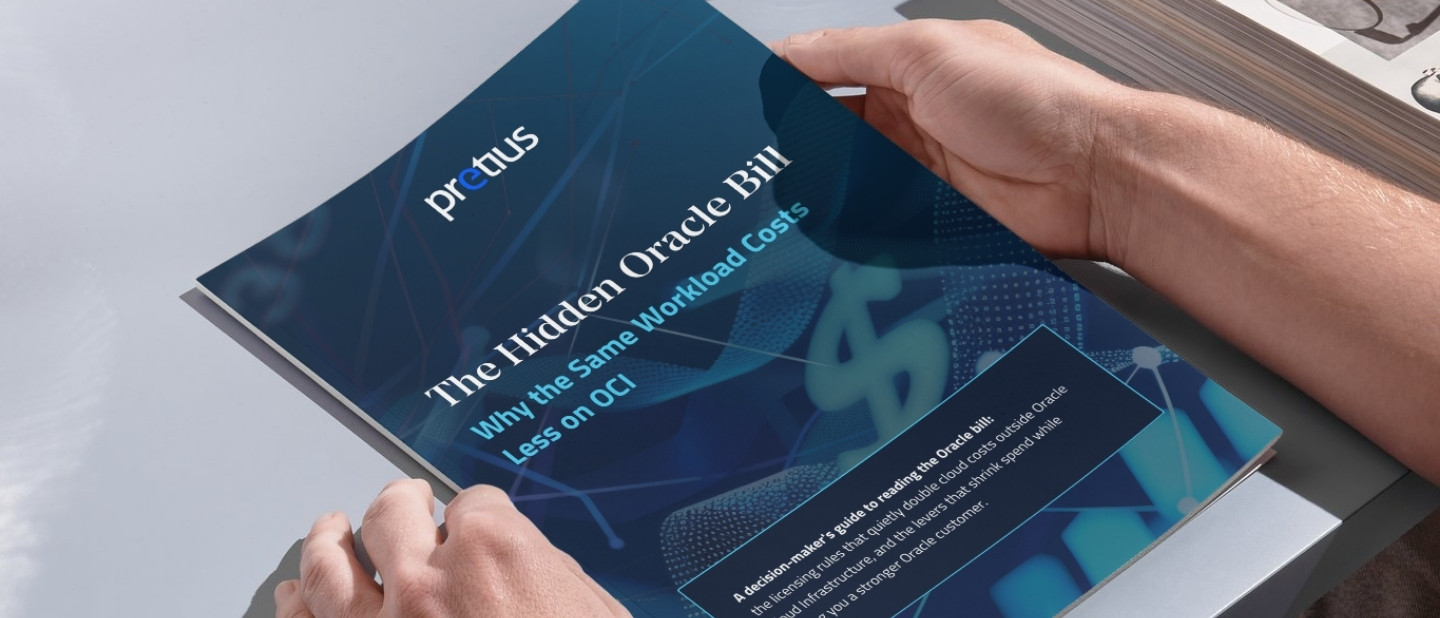
The same database workload can cost twice as much on AWS or Azure as it does on Oracle's own cloud, and most organizations have never checked. This guide gives IT and finance leaders everything needed to read the Oracle bill, see exactly where OCI changes the arithmetic, and act on the biggest savings, which come from getting more out of the Oracle ecosystem, not less: the anatomy of the bill, the cloud licensing decision, data residency without the premium, and a board-ready business case.

The Hidden Oracle Bill 01 Ebook

What's inside the playbook

20 pages, 7 chapters, written for the people who approve the Oracle budget and have to defend it. The playbook condenses what Pretius has learned across Oracle licensing reviews, OCI migrations, and APEX modernization for organizations like Warner Bros. Discovery, Munich Re HealthTech, and Sweco into one document you can take straight into a board meeting. It is pro-Oracle by design: most of the savings keep you firmly inside the Oracle ecosystem, and the biggest one moves you deeper into it. Every chapter ends with concrete takeaways, and most hand you a ready-to-use tool.

The anatomy of the Oracle bill: see what you actually pay

Oracle spend hides in plain sight: a few large invoices, many separately licensed products bought together, support compounding at 22 percent a year, and pricing expressed in cores and processors that finance cannot read directly. The playbook breaks the bill into its real layers, from the database and its options to middleware, analytics, and Java, so each one can be examined on its own. An oversized Oracle bill, it argues, is almost always an information problem you can fix, not a vendor problem you have to fight.

A layer-by-layer map of where Oracle spend actually goes, and a one-page inventory you can fill in from a single renewal notice.

The multipliers: how the bill grows without buying anything new

The largest gaps between what you pay and what you need to pay often come from mechanics, not purchases: the core factor and what happens to it in the cloud, the VMware rule that can require licensing an entire cluster instead of the two hosts running Oracle, database options switched on and never off, and editions over-specified for the workload. None of these are tricks; all are documented rules that are easy to miss when infrastructure and licensing sit in different teams.

A checklist of the five multipliers that inflate Oracle bills silently, and the benchmark that a typical internal review finds 10 to 20 percent of licenses inactive or over-provisioned.

Why the same workload costs less on OCI

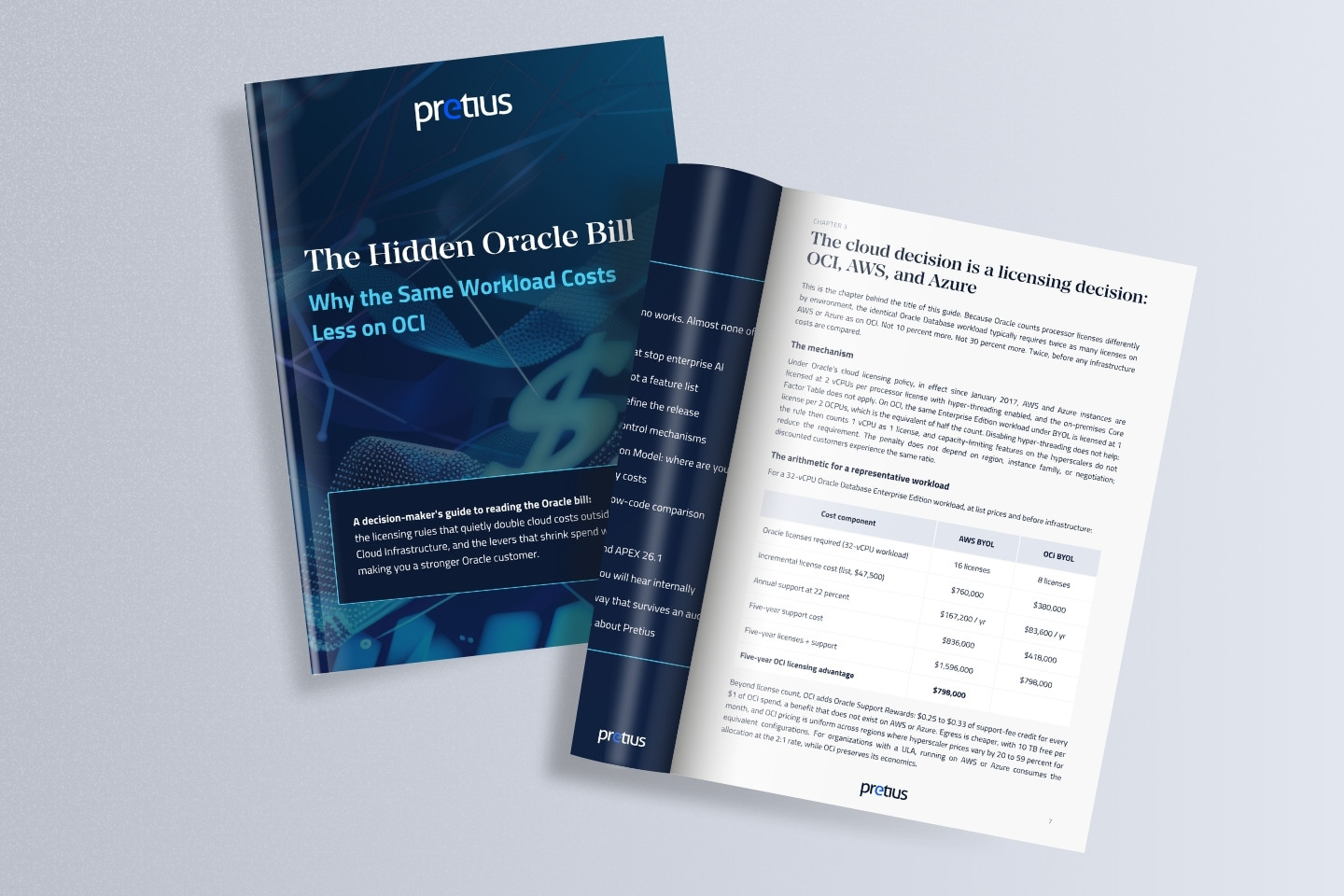
The title chapter, with the largest number in it. Because Oracle counts processor licenses differently by environment, the identical Oracle Database workload typically requires twice as many licenses on AWS or Azure as on OCI. For a mid-scale workload that is roughly $798,000 over five years, before infrastructure, Support Rewards, or lower egress. The playbook shows the full arithmetic and makes the pro-Oracle case plainly: moving your database to OCI does not reduce your Oracle commitment, it deepens it, on Oracle's own better economics.

A side-by-side five-year TCO table for OCI versus AWS, and three questions to test whether your own cloud placement is quietly overpaying.

Data residency without the premium

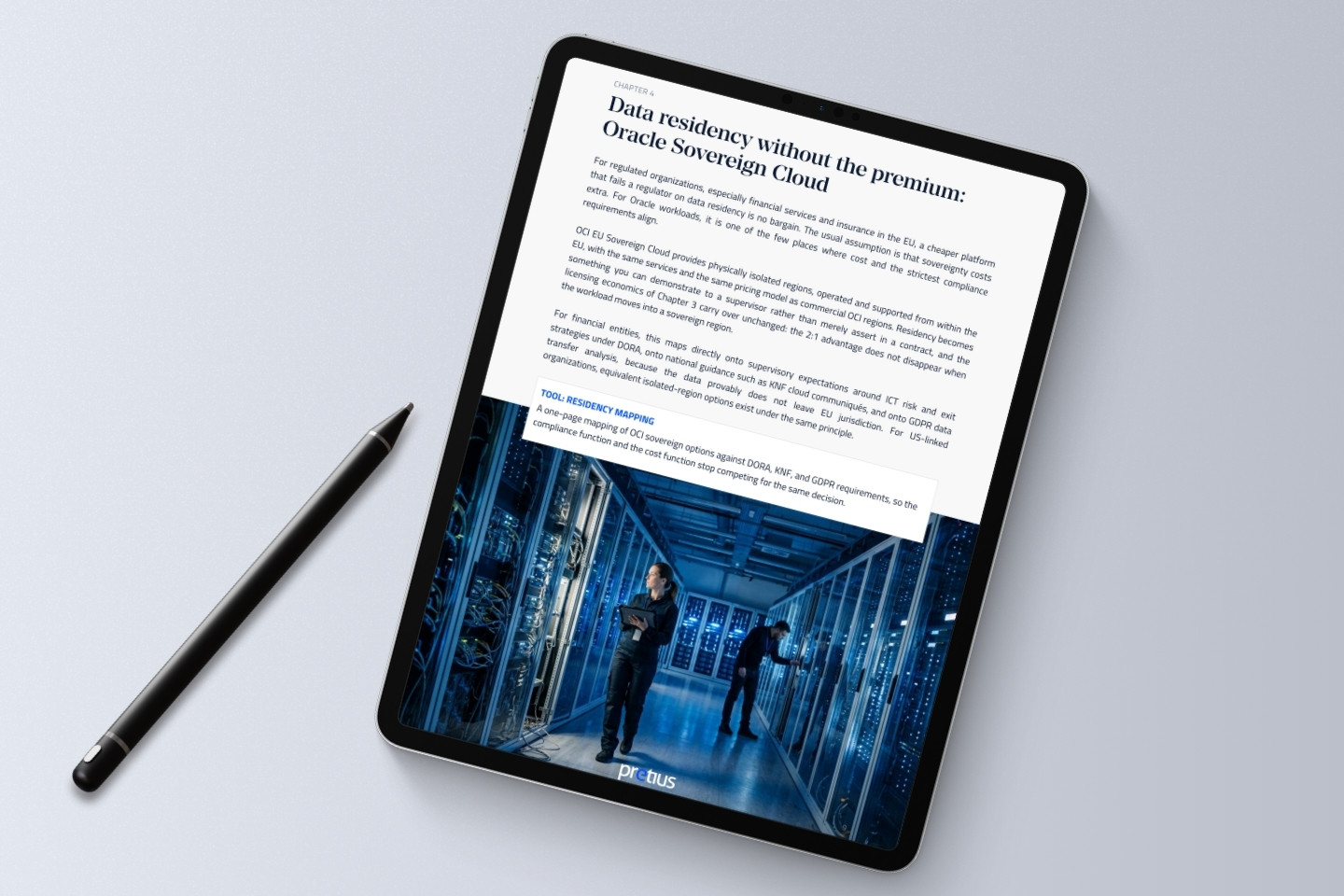
For regulated organizations, especially financial services and insurance in the EU, a cheaper platform that fails a regulator on data residency is no bargain. The playbook covers the one place where cost and the strictest compliance requirements align: OCI EU Sovereign Cloud, where physically isolated, EU-operated regions deliver residency you can demonstrate rather than merely assert, without surrendering the licensing economics that make OCI cheaper for Oracle workloads.

A mapping of OCI sovereign regions to DORA, KNF, GDPR, and US frameworks, so compliance and cost stop competing.

Shrinking the footprint with platforms you already own

The cheapest software is the kind you have already licensed. Oracle APEX is included free with the Oracle Database, yet many organizations pay six and seven figures a year for middleware, low-code subscriptions, and custom stacks it can replace. The playbook shows where that recurring cost goes and how to redirect it, and it is honest about the one lever that points away from Oracle, a full PostgreSQL exit, while explaining why that is the exception, not the recommendation.

A substitution scan that turns your subscription list into an APEX opportunity list.

Building the business case for the board

A board approves one number and a credible path to it. The playbook structures the proposal around three independent, cumulative levers that can be approved in stages, with payback stated plainly for each, and frames the whole case as becoming a smarter Oracle customer rather than a smaller one.

A five-line worksheet that produces the number for slide one from your actual invoices.

What to check on your Oracle bill this month

No program, no budget, no vendor conversation required. Ten checks you can run in an afternoon against documents you already have, turning an opaque bill into a short list of quantified opportunities.

The ten-point checklist, ready to hand to whoever holds the renewal notice.
The Hidden Oracle Bill 03 Ebook

Three ways to shrink the bill, in the order most organizations should try them

01

Optimize where you are

The license review: reclaim the inactive 10 to 20 percent, switch off unused options, right-size editions, and fix the exposures an audit would find first. Immediate payback, no migration.

02

Move the workload to OCI

The title lever: half the license count for the same workload, Support Rewards against your support fees, lower egress, sovereignty options for regulated estates. The deepest saving, and the one that strengthens the Oracle relationship.

03

Replace what the database already includes

APEX substitutions for middleware, low-code subscriptions, and reporting tools running against Oracle data; the honest PostgreSQL exit for the rare estate where leaving is right.

The e-book shows how the three levers stack, and why a board can approve them in stages.

Oracle Cloud Health Check

A fixed-scope, two-to-four-week engagement: license audit, current cloud cost baseline, and a vendor-neutral five-year TCO comparison of OCI, AWS, and Azure on your actual workloads. Most clients use the outputs whether or not they migrate.

APEX modernization & license footprint review

We quantify the substitution opportunity from Chapter 5 on your estate: which middleware and subscription lines the platform you already license can replace, with a phased plan and payback per line.

53 percent lower cloud costs in seven months

A regulated European insurance client moved production Oracle workloads from AWS to OCI.

Actual spend before versus actual spend after: 53 percent lower, within seven months of cutover, with zero hours of unplanned downtime and day-one regulatory compliance. The drivers were the ones this e-book explains: eliminating the 2:1 penalty, BYOL on OCI, right-sizing, and removing egress charges.
munich-re-logo
Branch
Health insurance
Country
Greece
SYSTEM
Insurance management

Download the e-book

The Hidden Oracle Bill 02 Ebook

Get “The Hidden Oracle Bill: Why the Same Workload Costs Less on OCI” and see what your own renewal notice has been hiding.


FAQ

The cloud counting policy applies to Oracle products licensed per processor in authorized cloud environments, including Database, WebLogic, and other technology products. The financial impact is largest for Database Enterprise Edition because of its list price.
Yes. Discounts move the absolute numbers, not the ratio: a workload that needs twice the licenses on AWS or Azure needs twice the licenses at any discount level.

Oracle permits license mobility between authorized cloud environments and on-premises, with no penalty for the move. Destination-platform terms apply from the date of deployment.

The opposite. Most of its savings keep you inside the Oracle ecosystem, and the largest one moves your workloads onto Oracle's own cloud. It treats the one exit path honestly, and as the exception.

Prices are USD list prices from public Oracle documents, with sources on the final page. Ratios between options are stable across discount levels; verify support dates and policy documents at decision time.

You get the PDF immediately. If you want the numbers run on your own estate, a Cloud Health Check does that in two to four weeks, and the first conversation is free.

Written by an Oracle partner with 20+ years on the Oracle stack

300+ specialists, five Oracle ACEs, ISO 27001, and production cloud delivery at media scale, including the Player.pl VOD platform serving 60 million monthly views. We advise on licensing because we live with the consequences of licensing, in systems we build and run.

pretius newsletter decorative image

Looking for a software development company?

Work with a team that already helped dozens of market leaders. Book a discovery call to see:

  • How our products work
  • How you can save time & costs
  • How we’re different from another solutions

footer-contact-steps

We keep your data safe: ISO certified

We operate in accordance with the ISO 27001 standard, ensuring the highest level of security for your data.
certified dekra 27001
© 2026 Pretius. All right reserved.