Pretius. Built Smarter: Strategic merger as an answer to modern challenges
Pretius. Built Smarter:
Strategic merger as an answer to modern challenges

How Pretius digitized on-site safety with an offline-first mobile app

decorative image

Company

Country

–

Industry

Construction

System

Mobile occupational health & safety (EHS) app

Executive summary: Offline-first safety on construction sites where the network doesn't reach

01

Client

The client is a leading construction company in Central Europe, managing thousands of its own workers and contractors across building sites throughout its country. On a construction site, health and safety is not paperwork. It is the difference between a controlled day and a serious incident, and it has to be enforced at the scale of thousands of people who move between sites constantly.

02

The core challenge

The client ran its safety supervision, daily briefings, and permit verification manually, on paper. At the company's scale that produced frequent errors, delays in getting hazard information where it needed to go, and slow reactions from supervisory staff. The hardest constraint sat underneath all of it: many construction sites had no stable network access, which ruled out ordinary online systems entirely. Any solution had to work where there was no signal at all.

03

Solution delivered

Pretius delivered a dedicated mobile health-and-safety app for iOS and Android that digitized the core safety processes. It verifies workers instantly by scanning QR codes, runs daily briefings fully offline, and captures multimedia documentation, photos and video, straight from the scene of an event. The heart of the solution is an automatic data-synchronization module that reconciles everything the moment a network connection returns. The app is integrated with the client's internal systems and runs on Microsoft Azure.
Key outcomes:
  • Real safety improvement across dozens of sites:
    The app improved safety on several dozen construction sites and became a key daily tool for EHS specialists.
  • Faster, digital briefings:
    Daily briefings were streamlined and sped up, and supervisors gained transparent, real-time reports.
  • Works with no signal:
    Full offline operation with automatic sync meant the app kept working on sites where the network didn't.
  • Audit-ready by design:
    The app became a trusted instrument in safety audits, which returned positive results when conducted with it.

Client background

The client is one of the largest and best-known construction companies in its market, running building contracts across the whole country. A general contractor of that size doesn't manage a workforce so much as a constantly shifting population: thousands of its own employees plus the employees of its subcontractors, arriving at and leaving dozens of sites, each of which has its own safety requirements, permits, and daily rhythm.

Safety supervision at this scale is a genuinely hard logistics problem before it is a software problem. Every worker on a site needs to be the right worker, with valid qualifications and up-to-date safety training, and every day begins with briefings that have to actually reach the people doing the work. Done on paper, as it had been, this generates exactly the failure modes you would expect at scale: gaps in verifying who is qualified for what, hazard information that moves too slowly, and processes that leave no clean audit trail behind them. The business consequence is not abstract. On a construction site, a gap in safety verification is an increase in the risk of an accident. Closing those gaps, and making the whole process auditable, was the reason for the project.
pretius case study construction 4

The business challenge: Manual safety processes that couldn't scale or reach

The safety processes worked on paper, but paper couldn't keep up with thousands of workers across dozens of sites, and often couldn't be used at all.
Two problems compounded each other. The first was the manual process itself. Supervising thousands of workers, both its own and subcontractors', by hand led to lapses in verifying permits and safety training, raised the risk of accidents, and left the whole process short on auditability. The second was infrastructural and, in a sense, more stubborn: many sites simply had no reliable network. That single fact disqualified the obvious answer of a standard online system, because a safety tool that stops working when the signal drops is worse than useless precisely where sites are most remote and most in need of it.

That situation created several concrete pressures:

  • Manual, error-prone supervision:
    Paper-based briefings and permit checks across a huge workforce produced errors and delays in getting hazard information to the right people.
  • Gaps in verification and auditability:
    Verifying the qualifications and training of thousands of own and contractor workers by hand left gaps and no clean record for audits.
  • No reliable connectivity on site:
    The lack of stable network access on many sites made standard online systems unusable and forced an offline-first approach.
  • Slow supervisory reaction:
    Information that moved on paper moved too slowly for supervisors to react quickly to emerging hazards.

Why a custom app, not an off-the-shelf tool

There are ready-made safety and workforce apps on the market, and choosing one would have looked like the faster path.
The client chose a dedicated build instead, for a reason that is specific and decisive: the app had to integrate fully with the company's internal systems and its particular data model, including mechanisms like snapshots of contractor-worker data. A generic tool can digitize a briefing, but it cannot natively speak the client's own permit and workforce systems, and it cannot be shaped around a data model that a large contractor has built up over years. The value of the app was inseparable from that integration, and integration of that depth is not something an off-the-shelf product offers. A custom application was the only way to put the digitized process and the company's existing systems on the same foundation.

The solution: A cross-platform, offline-first safety app

decorative image
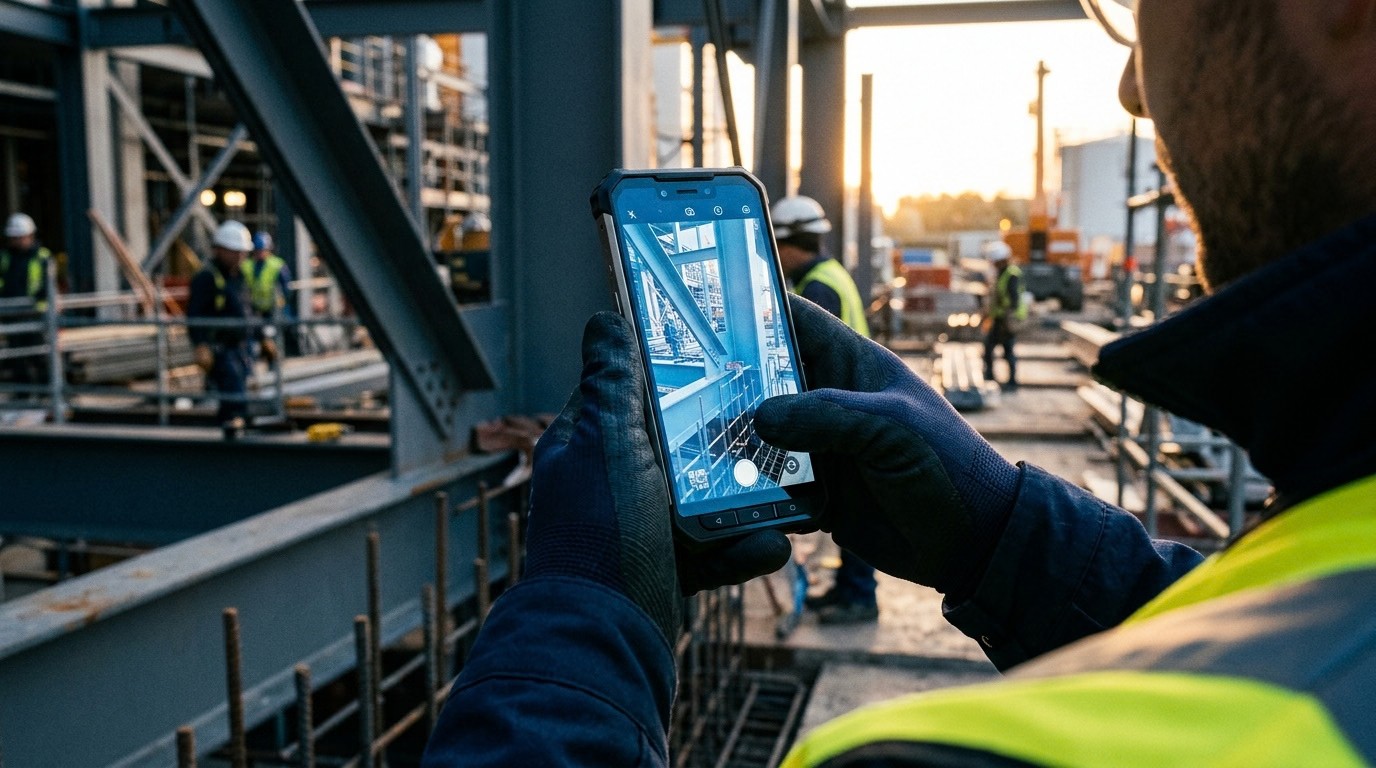
Pretius delivered a dedicated mobile EHS application for iOS and Android that took the core safety processes off paper and made them digital, fast, and, crucially, resilient to the absence of a network. Workers are verified in seconds by scanning QR codes. Daily briefings run entirely offline. Photos and video can be captured as evidence directly at the scene of an event. And when connectivity returns, an automatic synchronization module reconciles all of it back to the central systems without anyone having to think about it.

The app was built to integrate with the client's internal engineering and partner systems and to fit the company's specific data model, so that the digitized safety process and the existing workforce and permit systems operated as one. It runs on Microsoft Azure. The scope was deliberately bounded: work on the client's separate infrastructural and external systems was kept outside the project, so the effort stayed focused on the safety application itself.

The engagement ran for about six months on a fixed-price model, moving through analysis, development, a week of user acceptance testing, stabilization, and production rollout. A full-time, seven-person core team delivered it, and the collaboration later extended into additional commissioned work covering areas such as contractor-data snapshots and training statuses.

The delivery was built around four connected pillars:

01

Instant worker verification by QR

Scanning a QR code verifies a worker on the spot, replacing a slow manual permit check with a check that takes seconds. At a site gate handling a large, shifting workforce, that speed is the difference between verification actually happening and being quietly skipped.

02

Fully offline daily briefings

The daily briefing, the ritual that starts a safe working day, runs entirely offline. This is the feature that makes the app usable everywhere, not just on the well-connected sites, and it is what a standard online tool could never have delivered.

03

Multimedia evidence capture

Specialists can record photos and video directly at the scene of an event, turning observations and incidents into concrete, timestamped documentation. That evidence is what makes the whole process auditable rather than anecdotal.

04

Automatic synchronization on reconnect

The module at the heart of the system watches for the return of connectivity and then automatically synchronizes everything captured offline back to the central systems, so the field and the office converge on one consistent picture without manual effort.

Technologies and key architectural decisions

Every major decision on this project answered a specific, physical reality of the construction site: cross-platform reach, no network, and sensitive personal data.
flutter-logo

Flutter for one app across iOS and Android

The app was built in Flutter, giving a single, consistent UI across Android and iOS from one codebase and avoiding the recurring cost of maintaining two separate native apps. The non-trivial part was that this cross-platform app still had to integrate with advanced device hardware, in particular the QR scanners, which had to work reliably in real site conditions.
hive logo

A Hive local database for offline resilience

Offline operation is backed by Hive, a local database on the device that stores worker data and briefings so the app keeps working with no signal. The genuinely hard problem here was not storing data offline but reconciling it: handling the conflicts that arise when data captured on many disconnected devices has to be synchronized back to a single source of truth.
Keycloak logo

Keycloak for identity and access

Identity and access management runs on Keycloak, centralizing authentication and authorization. In an app handling workers' sensitive personal data, centralized identity management is a security requirement, not a convenience.

Node.js microservices on Azure

The backend is built on Node.js microservices and hosted on Microsoft Azure, a structure that fits the app's integration-heavy role and its need to scale across a growing number of sites.

The team

A full-time, seven-person Pretius team delivered the project: one business analyst, four Flutter developers, two backend developers, one manual tester, and one project manager, working in a fixed-price setup over roughly six months.

Navigating the hard parts: hardware, environments, and moving dependencies

A field application like this meets obstacles that never appear in an office system, and the team planned for the ones that mattered.
decorative image

01

QR scanning in difficult light

Scanning QR codes reliably in the uncontrolled lighting of a real construction site was a medium risk. It was addressed by optimizing the scanning libraries, so verification stayed smooth and fast in the conditions crews actually work in rather than only under ideal ones.

02

Cloud environments not ready at kickoff

The absence of prepared Azure environments before the start was rated a high risk, since it could have delayed everything downstream. The client provided the resources shortly after kickoff, and the work proceeded on schedule, but naming the risk in advance is what kept it from becoming a surprise.

03

Moving parts in adjacent systems

Because the app integrated with the client's other internal systems, changes in the front-end components of those adjacent projects were a low but real risk of regression. The team mitigated it by actively monitoring changes in the connected engineering system, avoiding regressions in the safety module before they could occur.

Measured outcomes and business impact

A field-proven safety tool that works where the network doesn't and stands up to audit.

Decorative image

Safer work across dozens of sites

The app is used on several dozen construction sites across the country and has produced a real improvement in on-site safety, becoming a key part of EHS specialists' daily work.
Decorative image

Faster briefings and real-time oversight

Digitizing the daily briefing shortened the process and gave supervisors transparent reports available in real time, replacing information that used to crawl along on paper.
Decorative image

Fewer manual errors

Taking permit checks and briefings off paper cut the errors that manual handling of these processes had generated, closing verification gaps across a huge workforce.
Decorative image

Audit-ready, and audit-proven

The app became a trusted instrument in safety audits, and audits conducted with it returned positive results, evidence that the digitized process holds up under formal scrutiny.
Decorative image

A responsive, ongoing partnership

Day-to-day the engagement stayed tight, with the client's project manager turning around requests within about one working day, and the relationship extended into further commissioned work covering contractor-data snapshots and training statuses.

Conclusion

This project shows how an offline-first mobile app can bring real, auditable safety discipline to environments where ordinary online systems simply cannot go.

The client did not need a generic safety app. It needed to digitize briefings, verify a huge and shifting workforce in seconds, and capture real evidence from the field, all on construction sites where the network frequently isn't there, and all wired into the company's own workforce and permit systems. By building the app in Flutter for a single cross-platform codebase, backing it with a Hive local database and an automatic synchronization module for genuine offline resilience, securing it with Keycloak, and running it on Azure, Pretius delivered exactly that.

The result improved safety across dozens of sites, sped up daily briefings, cut the errors of manual handling, and proved itself in formal audits, all while integrating deeply with the systems the client already relied on. For any organization whose work happens where connectivity can't be assumed, this project makes the case that offline-first is not a limitation to design around but a capability to build on.
decorative image

Looking for a software development company?

Work with a team that already helped dozens of market leaders. Book a discovery call to see:

  • How our products work
  • How you can save time & costs
  • How we’re different from other solutions

footer-contact-steps

We keep your data safe: ISO certified

We operate in accordance with the ISO 27001 standard, ensuring the highest level of security for your data.
certified dekra 27001
© 2026 Pretius. All rights reserved.