
Update (May 2026): The original version of this article was published in September 2024, just after we moved MonkeyJar to Oracle EU Sovereign Cloud in Frankfurt. Since then, a lot has changed — not on Oracle’s side, but around it. DORA has been in full enforcement for over a year, AWS launched its European Sovereign Cloud in January 2026, and the August 2026 EU AI Act deadline is now visible from where we’re standing. I’ve updated the regulatory section, added a comparison with the other hyperscalers’ sovereign offerings, and refreshed our own MonkeyJar experience based on what we’ve learned operating in EU SC for almost two years.
A polish bank we talked to last spring had a clean migration plan to a hyperscaler’s public EU region. The plan died on a single line in their DORA pre-audit: “ICT third-party provider operations and support personnel must be subject to EU jurisdiction, not parent-company jurisdiction.” Their candidate provider couldn’t credibly say yes. They started over.
Stories like this have been getting more common since DORA came into full enforcement in January 2025. Sovereign cloud — until recently a slightly niche concept — has quietly become a procurement requirement for entire sectors. This article is about one specific offering in that space: Oracle’s EU Sovereign Cloud. We use it ourselves for MonkeyJar, our sales-commission product, so what follows isn’t just a brochure read — it’s what we’ve learned running in it.
For many companies, this weirdly disconnected nature of the cloud meant potential issues. That’s when someone came up with the idea of digital sovereignty – and a while back, Oracle brought it fully into life with its new sovereign cloud services.
Digital sovereignty refers to a nation’s or entity’s control over its digital assets, data, and technology – to create, access, and govern digital information and infrastructure without undue external influence. Local regulations might require data to remain in an area within a certain jurisdiction and be operated only by personnel from within this area. In some cases, digital sovereignty rules might be more specific and complex, requiring comprehensive data protection or the use of separated clouds, disconnected operations, etc.
Let’s imagine that you’re running a business in one of the European Union countries. You don’t want your data (including the personal data of your customers) to leave the EU, not only because of European regulations but also your company’s security policies. The ideal situation would be that the servers with your data are located in the EU, they are maintained by EU citizens employed in a company registered in the EU, and everything works according to the European regulations (both the present ones and those that will probably soon come into force). That’s exactly what the sovereign cloud promises.
Digital sovereignty in 2026 is usually discussed at three levels, and they don’t all mean the same thing:
Most “sovereign cloud” marketing covers the first level cleanly and the second one partially. The third is where you have to read the actual contracts.
The Oracle sovereign cloud is a service – or rather a group or services because there are several different options – that allows companies to access the power of the cloud while meeting regulatory, compliance and legal requirements specific to their region or field of work. It offers the following capabilities:
Some numbers that put this in context: as of early 2026, Oracle has scaled the EU Sovereign Cloud operations team to more than 1,500 EU residents across seven dedicated EU-incorporated legal entities. The Frankfurt and Madrid regions each have at least three fault domains, and the regions can replicate to each other over a low-latency network without leaving EU territory. For a service that’s relatively quiet in the public discourse, the operational footprint behind it is actually substantial.
Specifics depend on the service – Oracle provides several sovereign cloud options (as shown in the image below), each designed for slightly different purposes.
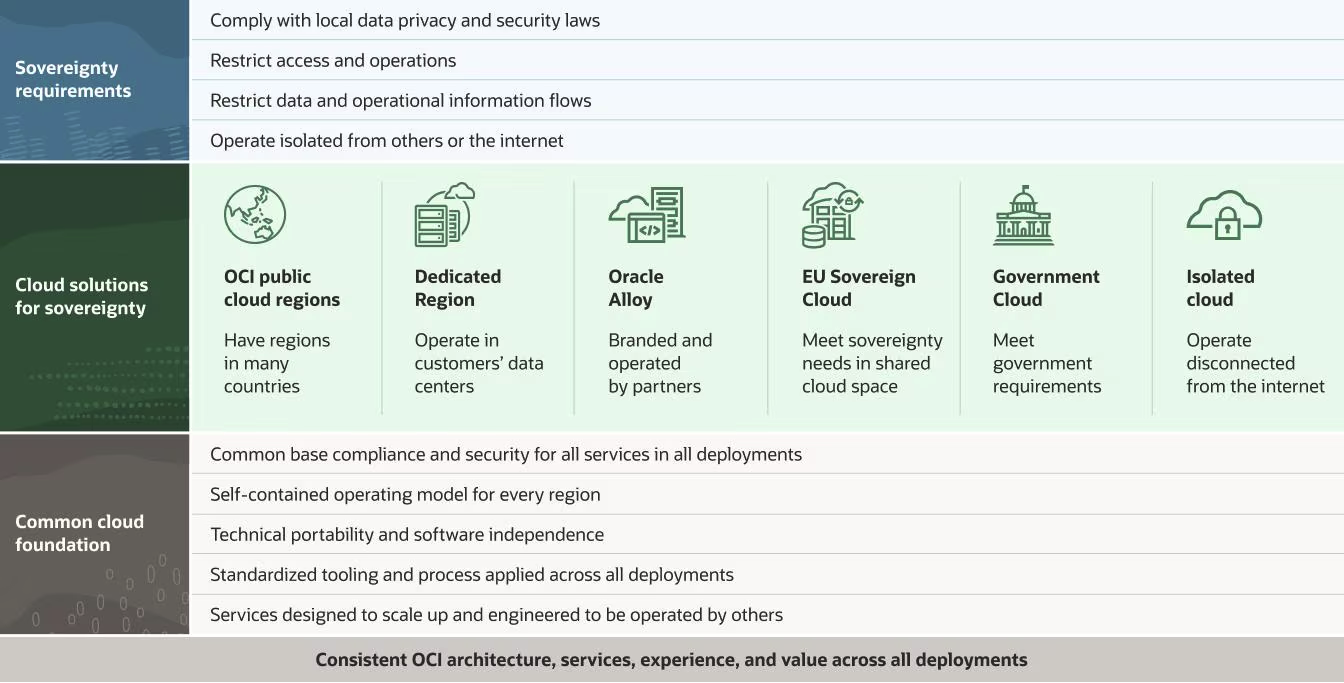
Image source: Oracle
Two years ago this section was a list of “industries that benefit.” That framing isn’t quite right anymore. For some workloads, sovereign cloud has moved from “nice to have” to “required by law.” Here’s where we see that playing out most clearly:
But let’s get down to specifics, taking our case as an example. We needed the sovereign cloud for our MonkeyJar product, a sales commission platform based on Oracle APEX. The service that interested us was the EU Sovereign Cloud, which currently offers servers in Frankfurt (Germany) and Madrid (Spain). We’ve chosen the former.
The main idea here was that we want to provide services for companies from the EU financial sector – banks, insurance businesses, etc. – that must adhere to local laws and compliance regulations such as GDPR. This meant that the data MonkeyJar handles could not be transferred outside the EU – our cloud server had to be housed somewhere on the continent. Moreover, it also meant the cloud’s support couldn’t be outsourced to a country outside the EU (because support often also needs to access data to provide help).
The EU Sovereign Cloud guarantees we meet these security and privacy requirements –and, as a result, allows us to sell our service to customers from the European Union. Since the server is in Frankfurt, it’s also close enough to us to help us avoid performance problems, and the support operates in the same time zone. Moreover – and this is one of the coolest things about the EU Sovereign Cloud – it doesn’t cost us extra money.
The pricing is the same as for the regular Oracle public cloud.
It would’ve been easy to make the sovereign cloud a separate premium product with a higher price tag, but Oracle didn’t do this. Instead, getting the EU Sovereign Cloud is as easy as choosing a server location for your OCI account – because that’s precisely what it boils down to (though enabling it for older accounts requires jumping through some additional hoops on Oracle’s part – it’s easier for newer accounts, which is a potential consideration). Seems like a very smart, business-conscious way of approaching this subject, one that the customers are bound to appreciate.
When we wrote the first version of this article in September 2024, we’d just finished migrating MonkeyJar to Frankfurt. Almost two years on, I can fill in some things you can only know after running in production for a while. A few things that turned out to matter more than we expected:
When the original version of this article went out in late 2024, Oracle EU SC was effectively alone in offering a hyperscale sovereign cloud in the EU. That picture is very different in 2026.
AWS European Sovereign Cloud (ESC) went generally available on January 15, 2026, operating from a region in Brandenburg, Germany, with Local Zones planned in Belgium, the Netherlands, and Portugal. It runs under a new German legal entity with EU-resident leadership and is physically and logically separate from the global AWS partitions. Two things to be aware of: independent analyses (tecRacer and others) have measured a roughly 15% pricing premium over standard AWS EU regions, and at launch, AWS ESC ships with about 90 services — a subset of the global catalogue. Bedrock model availability, in particular, is currently limited to Amazon’s own Nova models.
Microsoft Cloud for Sovereignty / Bleu (France) uses a partnership model — Microsoft’s technology operated by an independent EU entity (in France’s case, Bleu, the Orange-Capgemini joint venture). This typically delivers a higher level of operational sovereignty than a self-operated US-owned cloud, at the cost of some technological dependence on the upstream provider. Pricing premiums are in the 15–20% range.
Google S3NS is a similar partnership model with Thales, targeting France’s SecNumCloud certification primarily.
Oracle EU Sovereign Cloud has been operational since June 2023, runs from Frankfurt and Madrid under EU-incorporated Oracle legal entities with EU-resident-only staff, and — uniquely among the four — charges no premium over the commercial OCI public cloud. Service parity is also higher in percentage terms than at the newer hyperscaler offerings, simply because Oracle has had longer to build it out.
None of this means Oracle EU SC is automatically the right answer. The right answer depends on your existing stack, your AI/ML needs (where AWS and Google still have an edge), and how much your sovereignty requirement leans toward “EU data residency” versus “no possible US legal exposure.” But if you’re already running Oracle workloads — Oracle DB, APEX, Fusion Apps — the math gets very simple.
We didn’t just deploy to Oracle EU Sovereign Cloud as a customer — we became an official reseller of OCI. That’s not a badge we mention for its own sake. It changes what we can actually do for you.
As a reseller, we sit between you and Oracle on the commercial and technical side, which in practice means a few concrete things. You get a single point of contact who already knows your stack rather than a generic support queue. We can help size and provision the right services from the start — Autonomous Database, APEX, OCI Vault, Object Storage — instead of you discovering three months in that a service you assumed was there arrives a few months later in EU SC than in the commercial regions (a real gap we flagged earlier). And when a procurement team asks the “where is the data hosted, and by whom?” question, we can answer it with you, because we’ve had to answer it ourselves.
The reseller relationship also lines up neatly with the sovereignty conversation. Choosing EU Sovereign Cloud is, mechanically, just picking a server region on your OCI account — but the surrounding decisions (older-account migration hoops, service parity checks against your specific requirements, the DORA evidence file for Articles 29 and 30) are exactly where an experienced partner saves you time. We’ve been building on Oracle technologies for almost 20 years and running production workloads in EU SC for nearly two, so the advice you get is grounded in operating the platform, not just selling access to it.
Oracle’s sovereign cloud services seem to be a simple answer to a complex problem. The EU Sovereign Cloud, in particular – because that’s what we can speak about from our experience – offers companies an easy and cost-effective way to address at least a few important issues:
Three years on from its launch, Oracle EU Sovereign Cloud is no longer the experiment it was in mid-2023. It’s a working product with hundreds of paying enterprise customers, a 1,500+ EU-based operations team, and a track record long enough to actually evaluate. For Oracle-shop organisations facing DORA, NIS2, EHDS, or the EU AI Act, it’s now a serious default rather than an “interesting option to watch.”
At Pretius, we’ve been developing custom software based on Oracle technologies for almost 20 years. Are you planning a new project, or want to modernize a legacy system, and would like to consult somebody? Let us know using the contact form below or by writing to hello@pretius.com – such initial consultations are always free.